Aspire vape tank: reading the range by its coils
A British shop page lines up eight Aspire references side by side, all called tanks, all roughly the same size. Nothing tells you which ones share their coils, which aim at a tight draw, which want a powerful mod. The listing order used by retailers says almost nothing useful. There is another way of reading an Aspire vape tank, far more telling, and the brand itself has applied it for years.
An Aspire vape tank is read first by its coil family
At Aspire, the real dividing line is not the name on the tank but the coil family it accepts. Several families sit in the catalogue at the same time, and they are not interchangeable with one another.
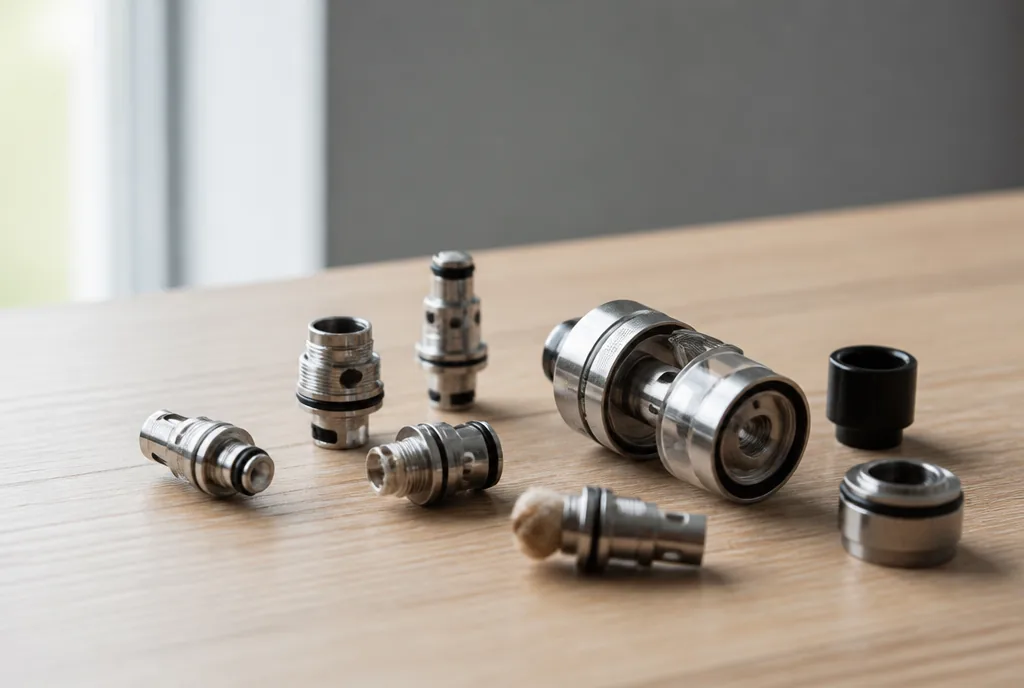
Nautilus models run on Nautilus coils, historically the BVC. The Huracan and its H2 derivative use BP coils, or BP-F for the lowest values. The AF Tank takes AF coils, and the Atlantis GT its own Atlantis SE coils. Picking a tank here means picking a consumable ecosystem for the whole life of the hardware.
That reading grid avoids the most common mistake made in a vape shop. You buy a tank that fits the mod, then discover the coils already sitting in your drawer will not screw into it.
What a tank does, and where Aspire sits
A tank is the upper half of an e-cigarette: a clear reservoir, a removable coil at the base, an airflow ring to set, and a mouthpiece you draw on. It screws onto a mod or a battery through the 510 fitting and is replaced independently of it.
Against an all-in-one pod, it adds one gesture, the coil change, but lets you choose reservoir, power and draw separately. Against a rebuildable atomiser, it removes the manual work of wire and cotton entirely.
In that landscape Aspire has held a recognisable position for a long time. Founded in 2013, the brand built its reputation on mouth to lung vaping, a restricted draw and approachable settings, rather than on chasing raw output. The Nautilus line is the heart of that stance.
One point of technical history explains the head start. The three letters BVC, for Bottom Vertical Coil, describe the small vertical coil screwed into the base of the tank, a principle these tanks did a great deal to popularise. Before that, wicks sat horizontally at the top of the reservoir.
Nautilus, the backbone of the range
The Nautilus line gathers several tanks built on one shared principle: vaping aimed at mouth to lung, airflow adjustable by a ring, and coils that screw in at the base. The variants differ mainly in diameter and in capacity.
The Nautilus 3 measures 24 mm across and takes BVC coils. Its D22 version drops to 22 mm, with top filling and adjustable airflow, for slim batteries that would not carry a wider tube. The Nautilus 3S keeps Nautilus coils, adjustable airflow and the 510 connection. Those three references cover the same use at different footprints, which is why they coexist.
Two more recent references step outside the strictly tight draw. The Nautilus 3 SR is presented for MTL and RDL use, with top filling, an interchangeable drip tip and coil values reaching down to 0.3 ohm. The Nautilus GT II carries the same mixed logic on 24 mm, with top filling and Nautilus coils quoted from 0.3 to 1.8 ohm.
RDL here means an intermediate draw, airier than MTL without reaching the full opening of DL. It is the term British listings use most often for that middle ground, and it is worth recognising on a product page.
What British capacity figures actually mean
Manufacturer capacities quoted internationally for these tanks, whether 3 ml, 4 ml or 4.5 ml, are not what you buy here. Under the Tobacco and Related Products Regulations 2016, which the MHRA administers, e-cigarette tanks sold in the United Kingdom are restricted to a capacity of no more than 2 ml.
So a compliant tank on a British shelf shows 2 ml on its spec sheet, whatever the same model is quoted at elsewhere. Some designs achieve that with an internal bung or a reshaped tube rather than a smaller body, which is why two versions of one tank can look identical.
The same regulations restrict nicotine containing e-liquid to 10 ml per refill container and to a strength of no more than 20 mg per ml, and require every product to be notified to the MHRA before sale. Reading a capacity figure on an overseas review therefore tells you very little about the item a British retailer will post to you.
Huracan and AF Tank, the departures from the line
Several references in the catalogue do not follow the Nautilus logic, and that is precisely why they exist. They address more powerful setups and a more open draw.
The Huracan Tank is a sub ohm tank with adjustable airflow, running BP coils. Its H2 version moves to 26 mm, with top airflow and BP-F coils quoted from 0.15 to 0.3 ohm. The AF Tank runs AF coils offered from 0.4 to 1 ohm, usable in MTL as well as DL.
None of those tanks accepts a Nautilus coil, and the reverse is equally true. That is the point retailer listings skate over most often: staying inside one brand is no guarantee that consumables carry across from one model to the next.
The four checks before buying an Aspire vape tank
A tank listing runs to a few lines, of which only three or four genuinely decide what daily use feels like. Here is the order in which to read them.
The coil family comes first, because it governs the consumable and how easily you will still find it in a year. Diameter comes second: beyond the width of your mod, the tank overhangs the deck and becomes awkward. The stated draw style, MTL, RDL or DL, is the only reliable indicator of the sensation. Capacity comes last, and on the British market it is 2 ml either way.
A fifth criterion deserves a glance, the filling method. Top filling, standard on recent models, saves unscrewing the tank over a worktop and is now the norm across the range.
Which model for which use
For a tight draw on a compact mod, the Nautilus 3 D22 remains the logical pick of the range. For the same behaviour without a size constraint, the Nautilus 3 or the 3S give identical results in a slightly larger body.
To move occasionally towards an airier draw without leaving the ecosystem, the Nautilus 3 SR and the GT II are the only references in the line covering both registers. For frankly sub ohm use, you have to switch to the Huracan or the AF Tank, and accept changing consumable at the same time.
An Aspire vape tank is therefore chosen in two steps: the draw first, the coil family second. The model name comes last, and it is almost always the thing people look at first.
FAQ
Are Nautilus coils compatible with older Nautilus tanks?
The screw-in base has been kept across the Nautilus line, which explains why many generations work together. Check the exact reference printed on the box all the same, since some values are no longer produced.
Can this tank go on a mod from another brand?
Yes, as long as the mod has a 510 connector, the standard shared by almost every manufacturer. The only thing to check is diameter, to avoid overhang on the deck.
What is the difference between a tank and a pod cartridge?
A cartridge belongs to one specific device and clips in, often magnetically. A tank screws onto any 510 mod and outlives the device it started on.
Why is the reservoir transparent?
That is the whole point of the format: seeing the remaining level without stripping anything down, and spotting an empty tank before you draw on it. These models keep a window or a glass tube throughout.
Should a new tank be rinsed before first filling?
A rinse in clean water and a full dry are enough to clear assembly residue. The coil itself goes in dry, then soaks for several minutes before the first puff.
Choosing an Aspire vape tank without guesswork
The catalogue looks crowded as long as you read it model by model, and turns simple the moment you read it by coil family. Three ecosystems, a long standing position on the indirect draw, and a few recent references opening towards RDL: that is the whole range in a sentence.
The same reasoning applies at other manufacturers, with different balances. Seeing how Innokin organises its own tanks throws the Aspire choice into relief, since Aspire preferred continuity to a multiplication of platforms. The wider guide to vape tanks covers the parts common to every brand, and the Zeus family at GeekVape shows a third answer again.
One last habit is worth keeping whatever you buy. Read the coil range printed on the coil itself rather than a figure quoted in a review, since that printed range is the only one matched to the exact reference in your hand. That single check settles most of the questions an Aspire vape tank listing leaves open.
This article is strictly informative and is written for adult vapers only. It is not a buying recommendation: depending on the reference, a vaping product contains nicotine, a substance that causes dependence. Nothing described here may be sold to under-18s in the United Kingdom.